We are launching a new newsletter — curated AI developer insights.Sign up

xAI ships Grok Build 0.2.7 with new commands
Grok

xAI ships Grok Build 0.2.7 with new commands

xAI has just rolled out Grok Build 0.2.7, adding /usage and /login commands, shared terminals across subagents, and improved image understanding. Early reactions range from workflow optimism to skepticism over time savings, rate limits, and version confusion.
claude cover
  • Claude

Anthropic launches Claude Opus 4.8 with faster, cheaper mode

Anthropic has just rolled out Claude Opus 4.8, touting sharper judgment, more honesty, and longer independent work. A new “Fast mode” promises roughly 2.5x speed and lower cost, while Claude Code gets deeper agentic workflows for long-running tasks.
codex cover
  • Codex

OpenAI to sunset GPT-5.2 and GPT-5.3 Codex models

OpenAI is set to sunset GPT-5.2 and GPT-5.3-Codex in Codex on June 2 for users signed in with a ChatGPT account. GPT-5.5 will become the default frontier model on free plans, while older options remain available via the API.
Anthropic ships Claude Code security plugin to catch bugs sooner

Anthropic ships Claude Code security plugin to catch bugs sooner

Anthropic has rolled out a new security-guidance plugin for Claude Code, designed to flag risky patterns during edits, model turns, and commits. The company says internal testing cut security-related PR comments by 30–40%, while users debate accuracy and false positives.

Introducing the Augmenter Newsletter

Get a curated digest of AI developer news, tutorials, and tools — delivered to your inbox. Designed for developers who want concise, useful updates.

Augmenter Logo

News and Insights on Agentic Coding, Vibe Coding and more

Augmenter is a human-curated collection of AI news, insights, and resources for developers. Content is written with AI, reviewed by humans, and designed to keep you up to date as technology moves forward.

Latest Articles

warp cover
  • Warp

Warp adds Cloud Handoff so agents keep running lid-closed

Warp has just rolled out Cloud Handoff, bringing automatic continuity to agent sessions when you close your laptop. The toggle lives under Settings > Agents > Warp Agent > Cloud Handoff, aimed at keeping long-running work from getting interrupted.
gemini cover

Antigravity adds Gemini 3.5 Flash Low to cut tokens 45%

Antigravity has just rolled out Gemini 3.5 Flash (Low), aiming to use about 45% fewer tokens than the Medium setting while still topping Gemini 3 Flash (High) on SWE tasks. Product lead Varun Mohan also says Gemini quotas were reset for all plans after user feedback.
David Sacks says AI is boosting, not killing, coding jobs

David Sacks says AI is boosting, not killing, coding jobs

David Sacks argues software engineer job postings are rising as AI makes coding cheaper, citing a “14x” jump in GitHub commits and a looming productivity boom. Critics say commits aren’t hires and the figure may reflect AI agents, not demand.
xAI brings Grok Build beta to SuperGrok and X Premium+
  • Grok

xAI brings Grok Build beta to SuperGrok and X Premium+

xAI has just rolled out Grok Build beta for SuperGrok and X Premium+ users, adding Plan Mode, Imagine image/video creation, and CLI automations. Early replies cite confusion about access, API keys, regions, and usage limits.
qwen cover
  • Qwen

OpenRouter adds Alibaba’s Qwen3.7-Max with prompt caching

OpenRouter has just rolled out Alibaba’s Qwen3.7-Max, positioning it as the flagship Qwen3.7 model for agent-centric coding, productivity, and long-horizon execution. The launch highlights claimed benchmark gains over Qwen3.6 and explicit prompt caching, as users press for more proof.

Featured Videos

Deep dive videos for AI developers

Miniature de la vidéo: Master Coding Agents Like a Pro (Anthropic’s Ultimate Playbook)

Master Coding Agents Like a Pro (Anthropic’s Ultimate Playbook)

The opening of the talk defines “vibe coding” as more than just using AI to help write code. The speaker argues that true vibe coding means letting the model handle the implementation to the point that you “forget the code exists,” while you focus on the outcome. He explains why this matters: as AI systems get better, they will be able to handle larger and larger chunks of work, making it unrealistic for humans to stay in a tight line-by-line review loop forever. He then frames the core challenge as how to use this approach safely in production. His answer is that engineers should stop obsessing over every implementation detail, but still stay accountable for the product’s behavior and quality. He compares this to managers or executives overseeing work they cannot personally execute in full detail: they succeed by verifying outcomes, requirements, and checkpoints rather than inspecting everything directly. A key caveat in this early section is tech debt. He says that unlike product behavior, tech debt is still hard to validate without actually understanding the code. Because of that, he recommends using vibe coding mainly on leaf nodes of a codebase, meaning isolated features where problems are less likely to spread into the core architecture.

Miniature de la vidéo: Ralph: Autonomous Coding Loops for Claude
13:25

Ralph: Autonomous Coding Loops for Claude

Autonomous coding loops can move fast—but without visibility and control, they can become hard to trust (and easy to run too long). This video walks through how Ralph Loop and the Ralph TUI add structure to long-running agent workflows, so you can track progress and intervene when needed. Key takeaways Covers what Ralph Loop is and how continuous iteration differs from a single-pass run in Claude Code. Breaks down why a task tracker and TUI matter as projects grow, including live task status and output streaming. Walks through setup: choosing a tracker (e.g., a local PRD JSON file), selecting an agent (Claude Code or OpenCode), and setting iteration limits. Demonstrates generating a PRD, turning it into a task list, and running sub-agents with pause/resume and session persistence.

Miniature de la vidéo: OpenSource Kimi K2.5 just dropped
14:45

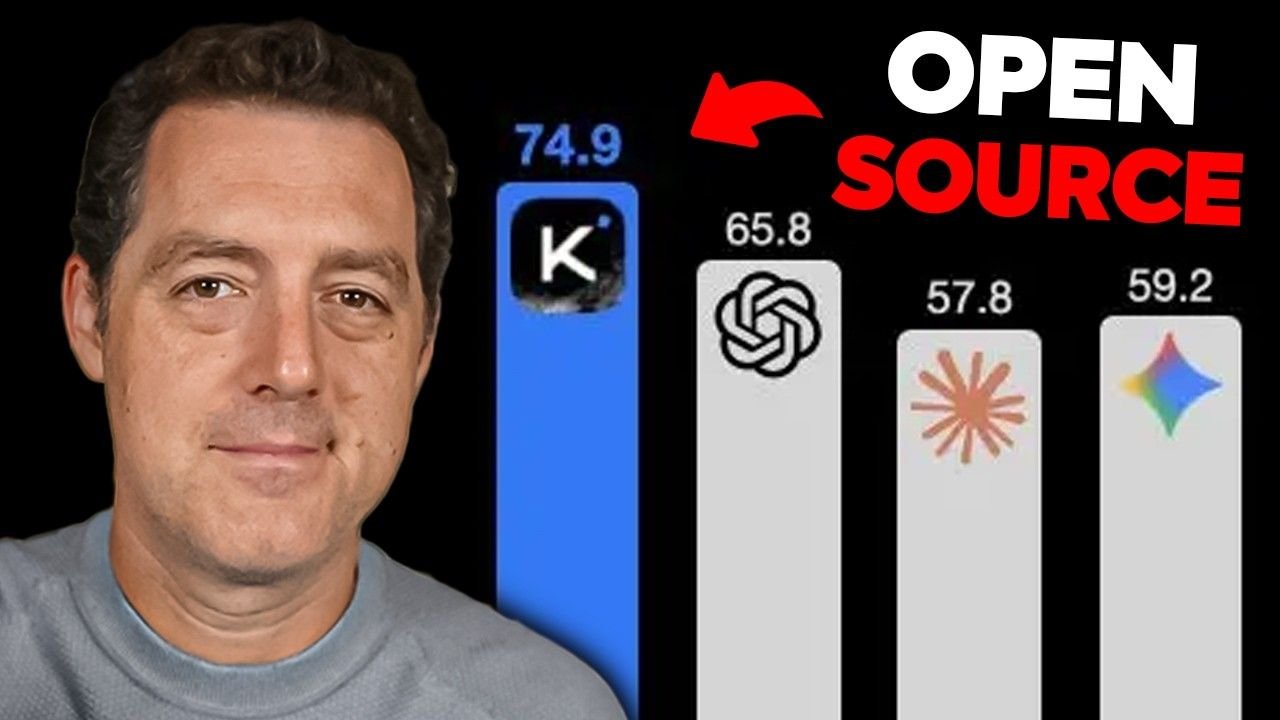
OpenSource Kimi K2.5 just dropped

Open-source weights are back—but for professionals, the real question is whether the latest drop meaningfully improves day-to-day coding, vision work, and agent workflows. This video walks through what Kimi K2.5 claims to deliver, where it benchmarks well, and what it looks like in hands-on demos. Breaks down Kimi K2.5’s focus areas: coding, vision tasks, and “self-directed” agent swarms Covers benchmark results across agentic, coding, and vision/video evaluations, plus cost vs. performance claims Shows practical examples like generating front-end websites and recreating a site from screenshots (no code provided) Demonstrates tool-using behavior, including a web-based price comparison and discussion of local runtime/VRAM needs

Miniature de la vidéo: From Vibe Coding To Vibe Engineering
25:28

From Vibe Coding To Vibe Engineering

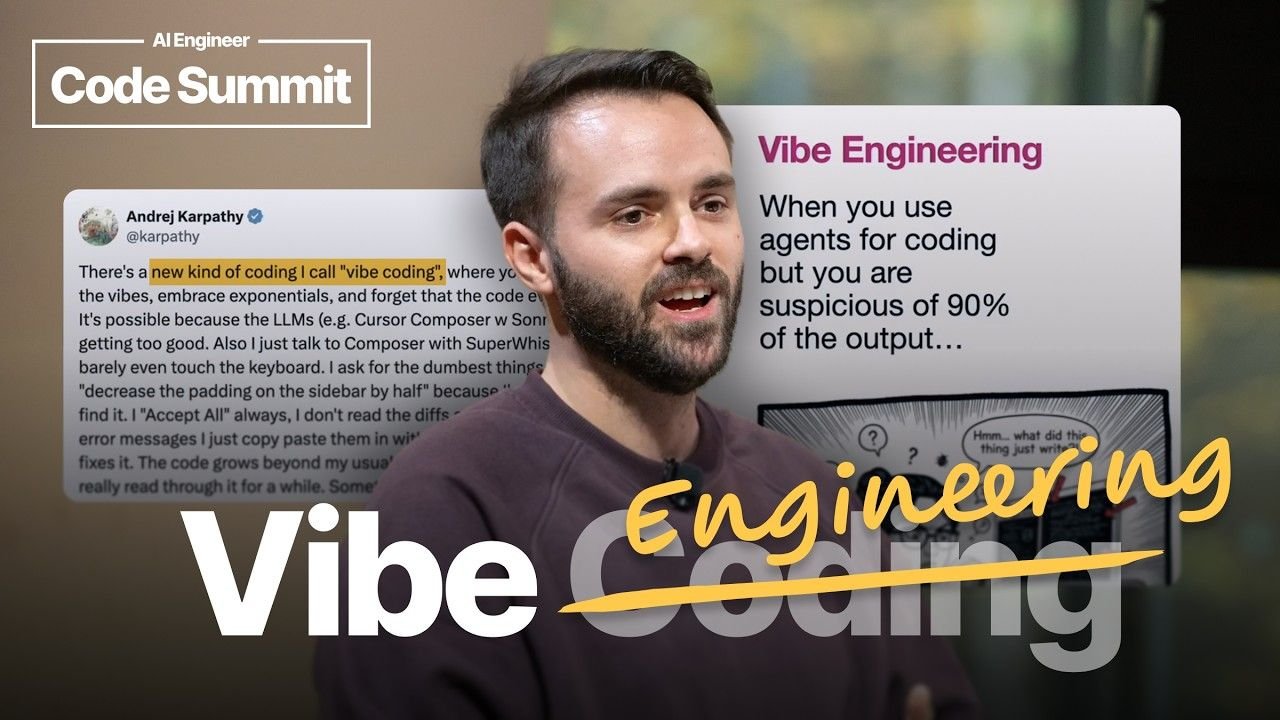
Frontend teams have always ridden hype cycles—but LLMs change the day-to-day work: you can “accept” code fast, and just as quickly land in the wrong abstraction. This talk reframes “vibe coding” into “vibe engineering,” focusing on how professionals can collaborate with AI without losing control of quality, context, and maintainability. Breaks down what “vibe coding” means in practice and why the definition keeps shifting Contrasts hands-off prompting with “vibe engineering” using agents—plus why you should stay skeptical of generated code Shares tactics the speaker uses (e.g., voice-to-code, starting from solid primitives, and supplying rules/docs/memory) Covers when vibing is appropriate (one-off scripts, simple features) and when it’s risky for teams and juniors

Miniature de la vidéo: Researchers solved the Context Window Limit
17:44

Researchers solved the Context Window Limit

Context windows cap what you can reliably ask an LLM to reason over—and as inputs grow, “context rot” can make quality drop fast. This video breaks down an MIT paper proposing recursive language models: a way to process arbitrarily long prompts at inference time without changing the core model. Key takeaways Covers why stuffing more tokens into a prompt can degrade retrieval and reasoning, even before hitting the physical limit. Walks through the RLM setup: storing the long prompt in a Python/REPL environment and giving the model tools to search it. Explains the “recursive” step—re-querying relevant sections to go deeper without summarization or compression. Reviews how the approach is evaluated on long-context tasks (e.g., BrowseComp+, Oolong, code repository understanding) and what tradeoffs show up in cost variance.

Continue the conversation on Slack

Did this article spark your interest? Join our community of experts and enthusiasts to dive deeper, ask questions, and share your ideas.

Join our community